
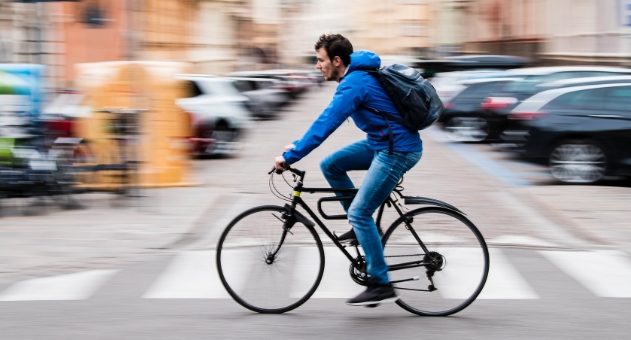
Cycling, an ode to slowness and vulnerability

Why did you want to talk about this topic today?
Because when you cycle, you experience very directly what it means to be vulnerable in a public space. You become aware of power imbalances that often go unnoticed when you are protected inside a car.
When I cycle, I regularly feel as though I am not being taken into consideration. At some junctions, even when I have the right of way, motorists continue driving without slowing down. If I were behind the wheel of a car, they would probably stop. But cyclists sometimes seem to “matter less”. Yet it is precisely because they are more vulnerable that they should receive greater attention. This vulnerability is well documented: in France, more than 235 cyclists lost their lives on the roads in 2025, while several thousand were seriously injured.
What does this situation teach us about our behaviour?
It often reveals an implicit principle: the strongest road user sets the pace. As a cyclist, staying safe sometimes means giving up my right of way, anticipating other people’s actions and remaining twice as vigilant. Cars have both speed and space on their side, which naturally gives them a dominant position on the road.
This creates an interesting paradox. Bicycles take up less space, produce virtually no pollution and reduce nuisance, yet cyclists are often perceived as the ones causing an inconvenience. This perception says a great deal about our relationship with speed and performance.
You also mention the issue of speed and impatience…
Yes, and this is probably one of the most revealing aspects of our society today.
When I cycle, I am very often overtaken in dangerous conditions: across solid white lines, on bends or along narrow roads. It is as though slowing down for a few seconds behind a cyclist has become unbearable. What is most striking is that I often catch up with the same cars 100 metres further down the road, stopped at a red light, while I calmly make my way to the advanced stop area for cyclists.
This raises an important question, is saving 20 seconds really worth putting lives at risk? Many risky behaviours are driven by the illusion of saving time. In reality, however, the benefit is usually minimal.
What message would you like to convey through this interview?
We live in a society that values speed and productivity. On the road, this results in impatient and sometimes aggressive behaviour. Excessive or inappropriate speed, for example, is involved in nearly 30% of fatal road accidents in France, which is far from insignificant.
Cycling reminds us of something essential, taking your time is not a weakness. Protecting the most vulnerable road users should be a collective reflex, because road safety does not depend solely on rules or infrastructure. It also depends on our ability to share space and take other people into consideration. A safe road is, above all, one where everyone adapts their behaviour to the vulnerability of others.
You recently referred to Bird’s accident triangle. How does this model help us understand risk more effectively?
I did indeed discuss Bird’s accident triangle during our latest conference at the Salon des Maires et des Collectivités Locales.
The idea is simple but powerful. Before a serious accident occurs, there are many hazardous situations and unsafe behaviours. Once someone enters this danger zone, the eventual severity of the incident often comes down to chance. Genuine prevention therefore means taking action before an accident happens.
This begins with awareness-raising and training, as well as appropriate road design and infrastructure. The impact of deterrent measures, such as speed cameras, should not be overlooked either, as they help reduce risky behaviour. According to the French Road Safety Authority, speed cameras have contributed to an average 66% reduction in fatal accidents near the areas where they have been installed.
Many offences do not stem from a deliberate intention to cause harm, but rather from a split-second decision, trying to save a minute, assuming “it will be fine” or believing that risks mainly concern other people. This is also why measures such as speed cameras are effective: they create a visible and consistent consequence.
Road safety is not only a technical matter. It is a matter of collective culture.
Contact us
Fields marked with * are required.