Functional Analysis & Control Narratives:
Reducing Project Risk Before Software Development Starts
In automation and ICSS projects, many issues only become visible during FAT. Unexpected behaviors, missing interlocks, misunderstood sequences, late design changes… all of these issues cost time, money, and trust. In most cases, the root cause is not the software itself. That’s why a rigorous Functional Analysis and Control Narrative phase is essential to secure your project before software development even begins. When functional requirements are not clearly defined and validated early, the software phase becomes longer and harder to control.
A Detailed Functional Analysis to Align All Stakeholders
Our approach starts with a thorough functional analysis that translates process intent into clear control requirements to define:
Operating modes and transitions
Control sequences and interlocks
Alarms, permissives, and safeguards
Manual and automatic behaviors
Degraded operation scenarios
Control Narratives That Remove Ambiguity
Control narratives are more than documentation. They are the backbone of a predictable and testable automation system. Our control narratives are:
Structured and consistent across units and packages
Directly traceable to P&IDs, cause & effect, and safety requirements
Written to be implementable and testable
This level of clarity significantly reduces interpretation errors and late functional changes.
“Functional analysis is a strategic step that turns process intent into precise and testable automation logic. Executed correctly, it safeguards schedules, budgets, and client relationships from costly surprises.”
Lamine Bouras
Engineering Manager
Freezing the I/O List: A Key Milestone to Secure Hardware and Software
One of the most critical outcomes of a solid functional analysis is the ability to freeze the I/O list early. With validated control narratives, we enable:
Finalization of I/O lists before hardware configuration
Reduced rework during software development
More predictable programming phases
Reducing Software Development Time and FAT Risk
When functional requirements are clearly defined:
Software development becomes faster
Coding follows a clear and stable reference
FAT scenarios are already known and anticipated
As a result, FAT shifts from a risk-heavy validation phase to a confirmation step, rather than a discovery phase.
“When your instrumentation data is reliable, everything else becomes easier: maintenance, engineering, planning, audits... Instrumentation Management brings back clarity and performance to systems that have evolved for years without a global view.”
William Guillaume
Sales Manager
Across many industrial facilities, instrumentation assets age faster than databases are updated. Devices become obsolete, information is scattered or inaccurate, and teams lose valuable time searching, verifying, and correcting data that should already be reliable.
The consequences are clear: difficulty planning interventions, higher risk of errors during replacements, reactive rather than proactive maintenance, and loss of operational performance.
To address these challenges, we developed Instrumentation Management — a complete, end-to-end methodology combining data reliability, instrumentation engineering, and controlled equipment replacement.
A centralized and reliable database: the foundation of a controlled instrumentation asset base
You can’t manage your instrumentation effectively when your data is outdated or fragmented. That’s why the instrumentation 360 begins with one essential step: cleaning, validating, and consolidating your information.
We help you:
Perform a complete and structured inventory
Verify, correct, and enrich existing data
Build a centralized and maintainable database
Provide reliable information for engineering, maintenance, audits, and planning
Rigorous instrumentation engineering focused on performance
Our approach is built on a detailed technical analysis of your installed base to ensure cost-effectiveness and long-term reliabilityand it includes:
Assessment of existing equipment
Replacement or upgrade recommendations
Standardization of instruments wherever beneficial
Definition of functional and technical specifications
Full preparation for procurement, installation, and commissioning
Controlled Equipment Replacement Without Impacting Availability
Replacing critical instruments should never disrupt your production. We ensure a progressive, safe, and coordinated transition:
Optimized replacement strategy
Planning aligned with your operational constraints
Supervision or execution of field replacements
Commissioning and systematic validation of correct functioning
“Modernizing a multi-vendor ICSS is never just a technical challenge. It’s about keeping the plant running, reducing risk, and ensuring every decision supports long-term performance. Our role at PARIFEX is to make that transition seamless and secure.”
William Guillaume
Sales Manager
PARIFEX helps industrial sites integrate (Greenfield) or modernize (Brownfield) their multi-vendor ICSS/automation systems with a fully customer-centric approach. Our missionis easy: simplify your operations and strengthen your security.
Upgrade Without Interrupting Your Operations
Your production cannot stop, even during major transformations. You stay productive, even through critical project stages. We design robust, scalable ICSS architectures that ensure:
Maximum operational continuity
Smooth and controlled migration phases
Reduced risk of unplanned downtime
Connect and Harmonize Multi-Vendor Technologies
Every facility is unique, that is why we seamlessly integrate and streamline heterogeneous technologies to deliver:
Full interoperability
Simplified day-to-day operations
A unified system ready to evolve with your needs
Strengthen Your Cybersecurity Where It Matters Most
As OT cybersecurity is no longer optional, we ensure full compliance with leading standards so that your operations remain protected in an increasingly challenging cyber landscape. We secure your infrastructure through:
Hardened and segmented architectures
Reduced attack surfaces
Rigorous validation and testing processes
Your operations remain protected in an increasingly challenging cyber landscape.
A Project Approach Built to Deliver on Time
Industrial projects demand precision and clarity. We support you with:
Detailed and transparent planning
Clear and efficient project management
Structured deliverables at every stage
Testing strategies that anticipate and prevent surprises.
To deliver an ICSS that is more reliable, more secure, and easier to operate, while guiding your transformation with a practical, flexible, and results-driven approach.
For more than 30 years, PARIFEX has been a trusted partner for companies seeking to enhance their industrial performance, safety, and reliability of their automation and supervision systems. With proven expertise, we support you throughout every stage of your industrial transformation: comprehensive system audits, seamless migrations with zero downtime, optimization without additional CAPEX, strategic instrumentation management, and the implementation of robust cyber-compliance to protect your operations for the long term.
Beyond our technical excellence, we offer a strong international engineering capability. With offices in France and Malaysia, our teams of passionate experts – specialized in automation and instrumentation – deliver tailored engineering, configuration, and installation services for projects deployed around the world.
PARIFEX helps you benefit from a comprehensive and results-driven partnership. We combine innovation, responsiveness, and operational excellence to ensure the durability, security, and maximum efficiency of your installations—today and into the future.
ICSS INTEGRATOR
We support our customers in the integration (Greenfield) and modernization (Brownfield) of their multi-vendor ICSS/automation systems, guaranteeing a secure solution that complies with cyber requirements and meets deadlines.
PRODUCTION OPTIMIZATION
We help you optimize the performance of your facilities, availability, safety, and production performance (OEE), by adjusting process and PLC settings, without CAPEX investment.
SITE SURVEY
Gain complete visibility into the health, obsolescence, and vulnerabilities of your OT assets through a comprehensive SCADA/ICSS audit. Equipment lifespans are extended and cyber risks are anticipated.
FUNCTIONAL ANALYSIS & CONTROL NARRATIVE
Reduce risks of FAT failures due to detailed engineering unconsistencies and ensure the full compliance with your client’s expectations before starting software developments. Freeze I/O list for hardware configuration and reduce software programming phase.
LIFECYCLE +
Anticipate SCADA/ICSS support discontinuations through a comprehensive health, cybersecurity, and obsolescence audit, as well as a costed action plan to reduce risk and OPEX.
REPLACE – MIGRATE – UPDATE
Security, compliance, performance: we help you combat the obsolescence of your monitoring system through migration or upgrades while maintaining production.
INSTRUMENTATION MANAGEMENT
Is your instrumentation obsolete and your database unreliable? We offer comprehensive support: a reliable, centralized database, engineering, and controlled equipment replacement.
Risky behavior: why are our roads still dangerous?
In 2025, driving in France remains marked by persistent tension. The 15ᵗʰ Responsible Driving Barometer, published by the VINCI Autoroutes Foundation, reveals a mixed picture: modest progress alongside deeply rooted risky habits.
Between aggression, normalized traffic violations, digital distractions, and driver fatigue, the challenge of making roads safer and calmer remains significant.
Aggressive behavior still present
The report reveals that 87% of drivers fear the aggressiveness of other road users. In fact, more than six out of ten motorists admit to insulting another driver in tense situations, while over half confess to honking aggressively.
Nearly a third admit to deliberately tailgating another vehicle out of annoyance, and 13% have already stepped out of their car to “confront” another driver. Although these figures are slightly decreasing, they still reflect a climate of persistent stress behind the wheel.
Yet, driver aggression significantly increases the risk of serious accidents: impulsive behaviors like dangerous overtaking, sudden braking, or physical confrontations can lead to collisions and severe injuries. Learning to manage stress and adopting a more respectful attitude on the road are therefore essential for everyone’s safety.
Road rules and responsible driving still not fully respected
Nine out of ten drivers… many drivers admit to exceeding speed limits often slightly, but regularly.
Yet, excessive or inappropriate speed is a factor in nearly one-third of fatal accidents on French roads, according to the Road Safety Authority. Most drivers also fail to maintain safe following distances. On highways, many remain in the middle lane without reason, and one in four admits to overtaking on the right a prohibited behavior that causes dangerous confusion for other drivers and increases the risk of side collisions or accidents during unexpected lane changes.
These increasingly common practices stray from the principles of responsible driving and contribute to a shared sense of insecurity on the roads.
Digital Distraction: When Screens Take the Wheel
The Barometer also highlights that 75% of French drivers use their phone or GPS while driving. One in three reads or sends messages behind the wheel, and 84% admit to taking their eyes off the road for more than two seconds—the equivalent of traveling 72 meters without looking, at 130 km/h!
Fatigue further compounds this dangerous mix: 39% drive when they are very tired, and half of them have already experienced a microsleep episode, an extremely dangerous phenomenon, as just a few seconds of inattention can lead to veering off the road or causing a serious accident, especially on highways where speeds are high.
Even more worrying, 85% of these drivers say their mind regularly wanders, a sign of weakened focus, which is a major factor in road accidents. To reduce these risks, it’s recommended to take regular breaks, stay well hydrated, and if feeling drowsy or struggling to concentrate, not hesitate to stop and rest—or switch drivers.
Invisible but Dangerous Risks
Although driving under the influence of alcohol and drugs is decreasing, it remains a serious concern: 7% of drivers admit to driving above the legal alcohol limit, 2% after consuming cannabis, and 12% under the influence of medication that impairs alertness.
These figures are particularly worrying among 18- to 24-year-olds, who represent about 20% of drivers involved in injury-causing accidents, despite making up only 12% of the driving population.
According to the ONISR*, young drivers are also more frequently under the influence of alcohol or drugs at the time of fatal accidents, with nearly 30% affected, which explains their increased vulnerability on the roads. Despite some awareness of the dangers, many continue to take risks, highlighting the need to strengthen prevention efforts and encourage greater responsibility.
“We are deeply convinced that a company's success is measured not only by its financial results, but also by the impact it has on its employees, customers and the planet. That's why we don't compromise on ethical and responsible practices. We make a point of ensuring an inclusive working environment, where equality, transparency and respect for everyone are at the heart of our corporate culture.”
Franck Peyré
PARIFEX's CEO
PARIFEX is proud to have been awarded its very first EcoVadis medal, in recognition of the company’s many initiatives in the field of Corporate Social Responsibility (CSR). The first in a long series of EcoVadis awards, the French manufacturer of multifunction radars has been awarded the silver medal.This places PARIFEX in the top 15% of companies evaluated in the EcoVadis database over the last twelve months.
The Ecovadis assessment focuses on four main themes:
Environment
Labor
Human rights
Ethics and sustainable procurement
The EcoVadis medal attests to the positive approach adopted by the companies assessed as they work to improve their CSR management performance and generate a positive impact.
Every year, PARIFEX reinforces its commitment to Corporate Social Responsibility through numerous initiatives focused on the well-being of its employees, such as training in first aid, psychosocial risks and harassment, and the organization of events such as Quality of Life at Work Week and sports challenges.
The company is also committed to integrating a responsible approach into every stage of its projects, in order to limit their environmental impact. This includes optimizing freight flows, recycling packaging and reducing the power consumption of radars, projects and offices.
Finally, the development of an inclusive and ethical corporate culture is based on diversity and tolerance, strong values for the French entrepreneur.
Road traffic officers: the guardian angels of the highway
Road traffic officers on motorways play a crucial role in the safety of all users. These professionals often work in dangerous conditions, putting their own lives at risk to help drivers in difficulty. The Association des Sociétés Françaises d’Autoroutes (ASFA) assesses the safety of personnel working on licensed motorways, and the accident figures are alarming: every year, numerous accidents occur even though these workers are present on the scene to ensure safety, to respond in the event of an accident or to repair the infrastructure.
Road traffic officers in action: state of play
The Association of French Motorway Companies ASFA takes stock of the safety of road traffic officers on motorways and notes that the figures have been rising over the last three years. In fact, in 2023, motorway workers were the victims of an accident every two days on average. In the same year, the toll was 144 accidents, including 18 accidents resulting in injury, compared with 13 in 2022 and 12 in 2021.
Accidents generally occur when work site markings are put in place and during emergency interventions to rescue customers involved in accidents. Another danger, but not the least, is heavy goods vehicles, which are 49% responsible for accidents. Indeed, heavy goods vehicles overrunning onto the hard shoulder are the cause of numerous collisions with vehicles stopped for service reasons. In addition, one in four accidents involving motorway personnel occurs on the hard shoulder.
The highway, a place of danger
On the highway, men in yellow are involved in various activities essential to ensuring the safety and smooth running of the road network. This may involve marking roadworks or emergencies, intervening near a toll plaza, monitoring the removal of objects, repairing road signs or safety barriers, or salting roads and ensuring the flow of traffic in difficult weather conditions.
The majority of staff are also on the road to carry out liaison missions when they travel to or from an accident site. 36% of them were involved in an accident while responding to emergencies to help customers involved in accidents in 2023. These missions, although varied, all have a common objective: to guarantee the safety of motorway users. They put themselves in danger every day in order to avoid danger to as many people as possible.
Let’s look out for them
What if the roles were reversed and drivers looked out for their safety? It starts with respecting the emergency lane. On the motorway, it is essential never to encroach on the emergency lane, as this lane is reserved for vehicles in emergency situations. Encroaching on it exposes users to increased risk of accidents, as these areas are often close to vehicles in distress or road works.
Finally, it is enough to be more attentive to the various messages and signs indicating that an event is in progress on the highway and that it requires the presence of teams on the roadway. And to slow down…
It is essential to raise awareness of the importance of caution near intervention zones, which is why awareness-raising actions are carried out throughout the year.
Our company is fully committed to promoting professional equality between women and men. We are proud to note that in 2024, our gender equality index score has increased compared to 2023, reflecting our constant efforts to reduce gaps and promote inclusion. Aware that equality must be reflected at all levels and in all functions, we are implementing concrete actions to guarantee equal opportunities for all, while cultivating a respectful and equitable work environment.
Our objective
To reflect society’s commitment to promoting a corporate culture that is mindful of professional equality between women and men.
The policy revolves around 5 main themes:
Recruitment
Vocational training
Remuneration
Professional development
Respect on a daily basis
Following the calculation of the index for 2024, the overall score awarded is 89/100*.
This score is based on the following criteria:
1/ The gender pay gap = 36/40
2/ The distribution gap of individual increases = 35/35
3/ The number of female employees receiving a raise upon returning from maternity leave = NA in 2024
As we age, our driving habits evolve. More cautious than younger drivers, seniors on the road remain more vulnerable in the event of an accident. According to the road accident report conducted by ONISR (National Interministerial Observatory for Road Safety), in 2024, 527 people aged 75 and older lost their lives on French roads. While their involvement in accidents is relatively moderate, their physical frailty increases the mortality rate, which is 1.5 times higher than that of other age groups.
So, how can we better protect our elderly on the road?
More severe injuries, higher risk
In the event of an accident, the consequences are often more severe for seniors. But why? Due to their fragility, injuries are more serious, and recovery is more complicated. What might be a simple bruise for a younger driver can quickly become a life-threatening emergency for an older person. Aging also leads to slower reflexes, diminished vision, and sometimes hearing impairment, which increases reaction times. When a sudden brake or unexpected obstacle occurs, the margin for error is reduced, thereby increasing the risk of an accident. Moreover, chronic illnesses such as heart problems or diabetes can impair driving ability, as can certain medications that affect alertness and reflexes.
According to ONISR, in 2024, around 1,300 seniors were seriously injured on the road, a 7% increase compared to 2023. This alarming statistic highlights the importance of adapting both their driving and the road environment.
Outside urban areas: an underestimated danger
Contrary to what one might think, seniors are just as at risk in urban areas as on roads outside urban areas, where speeds are higher and the margin for error is smaller. 50% of pedestrian fatalities and 51% of cyclist fatalities on secondary roads are aged 65 or older, according to ONISR. Although mortality on these roads decreased between 2023 and 2024, the rate remains high.
On these roads, reaction time becomes a crucial factor. Signage can sometimes be more complex, with less visible intersections and poorly separated lanes, making decision-making more difficult for older drivers. Over time, distance assessment also becomes trickier. Estimating the speed of another vehicle or judging the distance needed to overtake can become more approximate, increasing the risk of dangerous maneuvers.
Seniors on the road: how to ensure their safety?
It’s not about taking away their driving license but rather ensuring they can drive in optimal safety conditions. But what are these solutions? Regular medical check-ups, as recommended by Cap Retraite, would allow closer monitoring of visual and auditory capabilities, as well as reflexes, to anticipate potential difficulties. Improved signage, with more readable signs and enhanced road markings, could also make driving easier and reduce mistakes, as noted by Silver Éco. On the vehicle side, new technologies offer valuable driving aids. Blind-spot detection, emergency automatic braking, and lane-keeping assistance help compensate for slower reflexes and prevent many accidents, according to the French institution Sécurité Routière. Finally, tailored training programs, as recommended by the Prévention Routière association, would offer seniors the opportunity to update their knowledge and better understand the changes in traffic laws.
Because aging well also means continuing to drive safely!











 We support our customers in the integration (Greenfield) and modernization (Brownfield) of their multi-vendor ICSS/automation systems, guaranteeing a secure solution that complies with cyber requirements and meets deadlines.
 We help you optimize the performance of your facilities, availability, safety, and production performance (OEE), by adjusting process and PLC settings, without CAPEX investment.
 Gain complete visibility into the health, obsolescence, and vulnerabilities of your OT assets through a comprehensive SCADA/ICSS audit. Equipment lifespans are extended and cyber risks are anticipated.
 Reduce risks of FAT failures due to detailed engineering unconsistencies and ensure the full compliance with your client’s expectations before starting software developments. Freeze I/O list for hardware configuration and reduce software programming phase.
 Anticipate SCADA/ICSS support discontinuations through a comprehensive health, cybersecurity, and obsolescence audit, as well as a costed action plan to reduce risk and OPEX.
 Security, compliance, performance: we help you combat the obsolescence of your monitoring system through migration or upgrades while maintaining production.
 Is your instrumentation obsolete and your database unreliable? We offer comprehensive support: a reliable, centralized database, engineering, and controlled equipment replacement.

 Although driving under the influence of alcohol and drugs is decreasing, it remains a serious concern: 7% of drivers admit to driving above the legal alcohol limit, 2% after consuming cannabis, and 12% under the influence of medication that impairs alertness.




 What if the roles were reversed and drivers looked out for their safety? It starts with respecting the emergency lane. On the motorway, it is essential never to encroach on the emergency lane, as this lane is reserved for vehicles in emergency situations. Encroaching on it exposes users to increased risk of accidents, as these areas are often close to vehicles in distress or road works.
![[INFOGRAPHIC] Pedestrian and Cyclist Safety in 2024](https://www.parifex.com/wp-content/uploads/2025/03/Velo_pieton_bus_ville_BD.jpg)
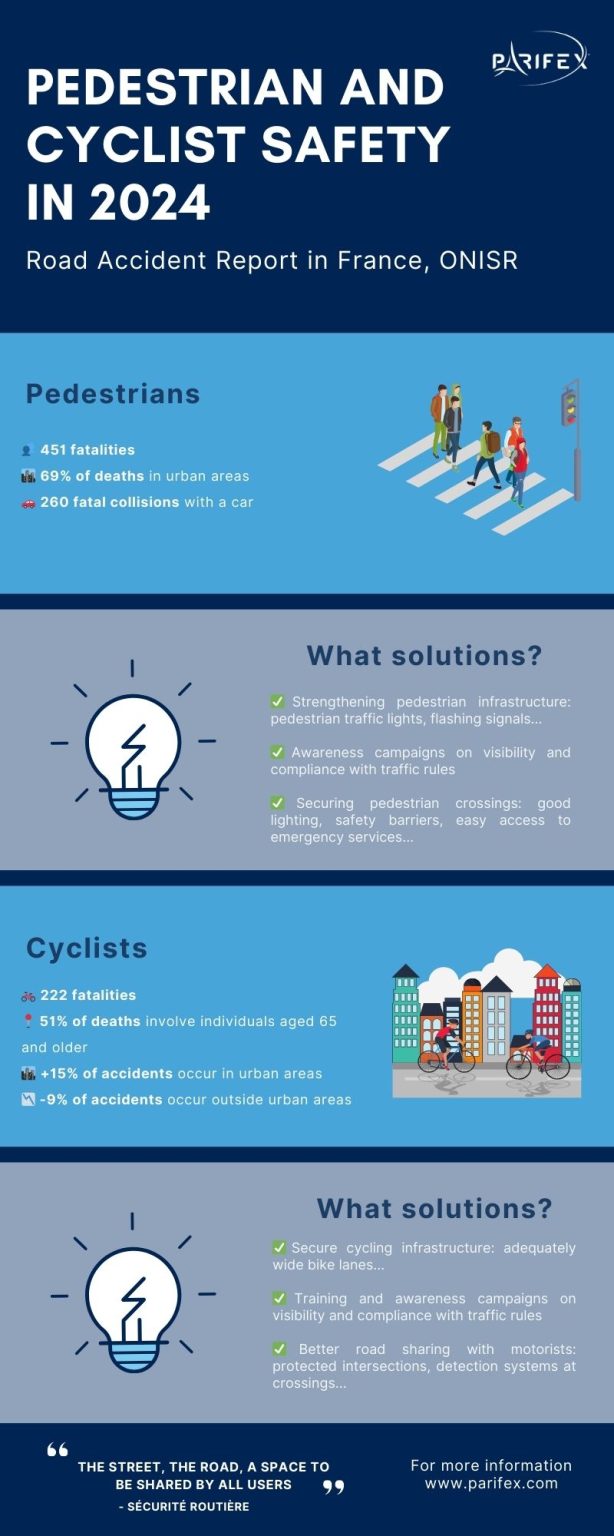




 Contrary to what one might think, seniors are just as at risk in urban areas as on roads outside urban areas, where speeds are higher and the margin for error is smaller. 50% of pedestrian fatalities and 51% of cyclist fatalities on secondary roads are aged 65 or older, according to ONISR. Although mortality on these roads decreased between 2023 and 2024, the rate remains high.